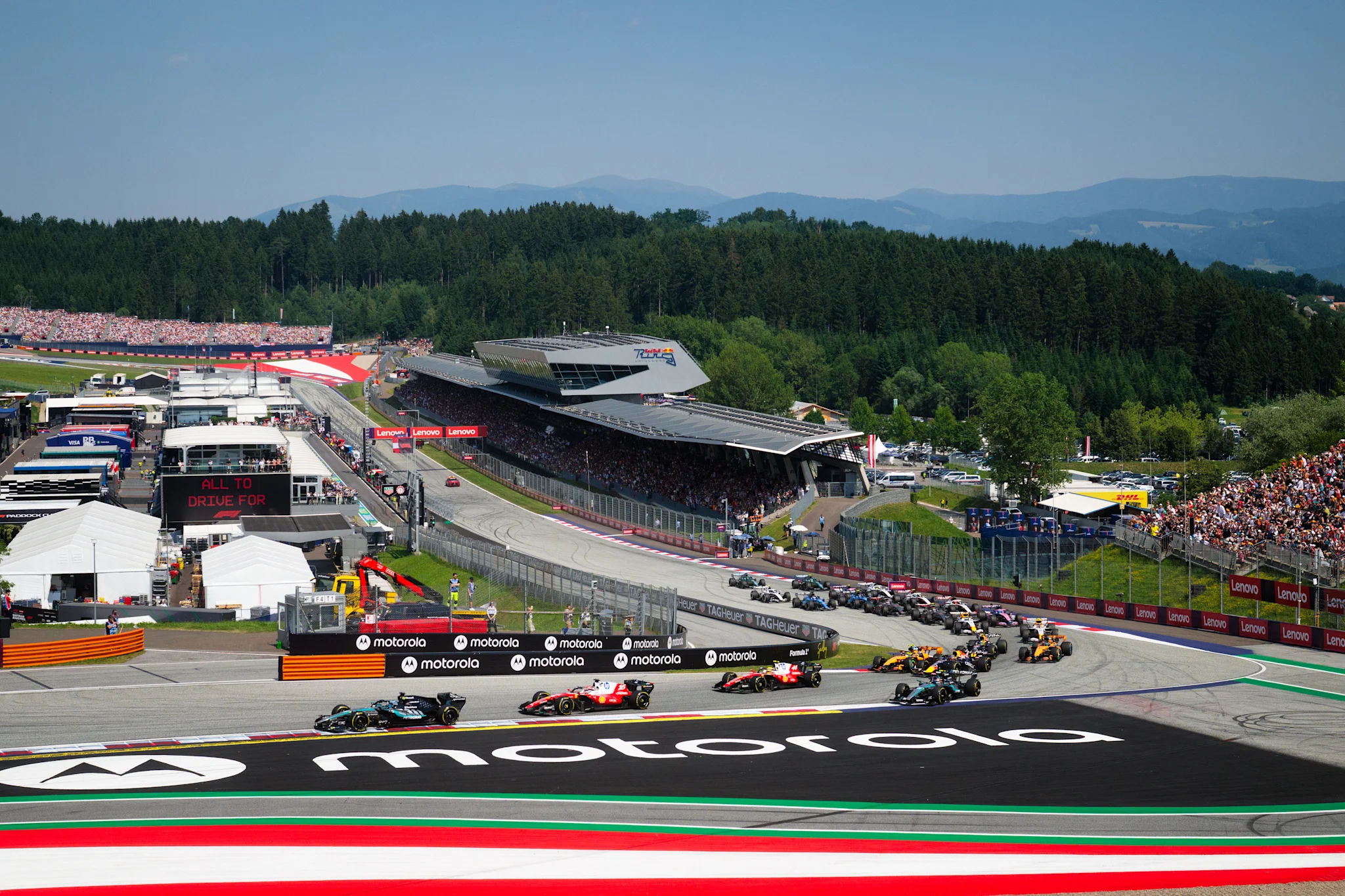
George Russell did the simplest-looking thing in Formula 1, which is also one of the hardest: he started first at the Red Bull Ring and finished first. No opera, no late-race tyre sermon, no strategic séance. Just pole, launch, control, flag. Very rude of him, frankly, to deny the content economy a meltdown.
But the Austrian Grand Prix data says this was not merely a neat conversion job. Russell won from pole in 86:37.979, yet the margin over Max Verstappen was only 1.611 seconds, with Andrea Kimi Antonelli another 0.375s behind Verstappen. The podium was covered by less than two seconds. Austria was not a Mercedes walkover. It was a pressure test, and Mercedes passed it with both cars.
The first hidden trend is that Mercedes did not just win the race; it maximised the whole competitive window. Russell took pole with a 1:06.113, a chunky 0.236s clear of Charles Leclerc. Antonelli was fourth in qualifying, only 0.301s off Russell, then converted that into third place and 15 points. Add the race haul together and Mercedes left Spielberg with 40 points, far more than Red Bull's 26, McLaren's 18, and Ferrari's 14.
That matters because the championship table now has a very Mercedes-shaped top two: Antonelli still leads on 171 points, but Russell is up to 131 after his second win of the season. The gap remains 40 points, yet the recent story has shifted. Antonelli still owns the standings; Russell now owns the argument that this title fight is not a coronation with nicer branding.
The second trend is McLaren's quiet contradiction. On Sunday, the result looked underwhelming: Oscar Piastri fourth from seventh, Lando Norris seventh from sixth, 18 points total. But the weekend lap table tells a more interesting story. Filtering the timed laps to exclude obvious pit-in/out and anomalous laps, Piastri had the quickest average of the weekend sample at 72.068s, just ahead of Russell's 72.123s. Norris was not in that same window, averaging 73.189s, but the car clearly had pace somewhere in it.
That is the annoying bit for McLaren. The data does not say "slow car." It says "incomplete weekend." Piastri gained three places and was the best non-podium finisher, while Norris lost one from his grid slot. In a season where Mercedes is banking enormous constructor points, McLaren cannot afford weekends where the underlying pace is better than the scoreboard.
The third trend is Ferrari's Sunday leak. Leclerc started second and finished eighth. Hamilton started third and finished fifth. A front-row-plus-third grid position became 14 points. That is not a disaster in the theatrical sense, but it is exactly the kind of slow bleed that makes a fast car look politically complicated by Monday morning. Qualifying said Ferrari was right there: Leclerc was 0.236s off pole and Hamilton 0.295s off. The race result said the car was not able to hold that promise under load.
Verstappen, meanwhile, produced the cleanest rescue drive of the front group. From fifth to second, 18 points, and within 1.611s of the win is not a footnote. Red Bull also had Isack Hadjar sixth from eighth, which made it a 26-point day. The wider standings still put Red Bull fourth in the constructors' championship on 115 points, behind Mercedes, Ferrari, and McLaren, but Austria looked less like a team adrift and more like one that had found a sharper race-day edge.
The field compression in qualifying is worth underlining. Russell's pole to Piastri in seventh was only 0.398s. Hadjar in eighth was 0.519s away. On a short lap like the Red Bull Ring, that is still meaningful, but it explains why tiny execution differences became big Sunday consequences. Ferrari slid. Piastri climbed. Verstappen climbed harder. Russell had clean air and the calm hands to keep it.
So the headline is Russell wins Austria. The useful version is richer: Mercedes turned a tight weekend into a 40-point statement, Verstappen made Red Bull look dangerous again, McLaren's data looked better than its result, and Ferrari converted Saturday speed into Sunday shrinkage. The stopwatch did not shout. It whispered, which is usually when it is telling the truth.
Sources and checks
- F1 Daily Brief API:
/api/v1/races/2026/8/results - F1 Daily Brief API:
/api/v1/races/2026/8/qualifying - F1 Daily Brief API:
/api/v1/races/2026/8/laps - F1 Daily Brief API:
/api/v1/standings/drivers/2026 - F1 Daily Brief API:
/api/v1/standings/constructors/2026 - F1 Daily Brief API:
/api/v1/news