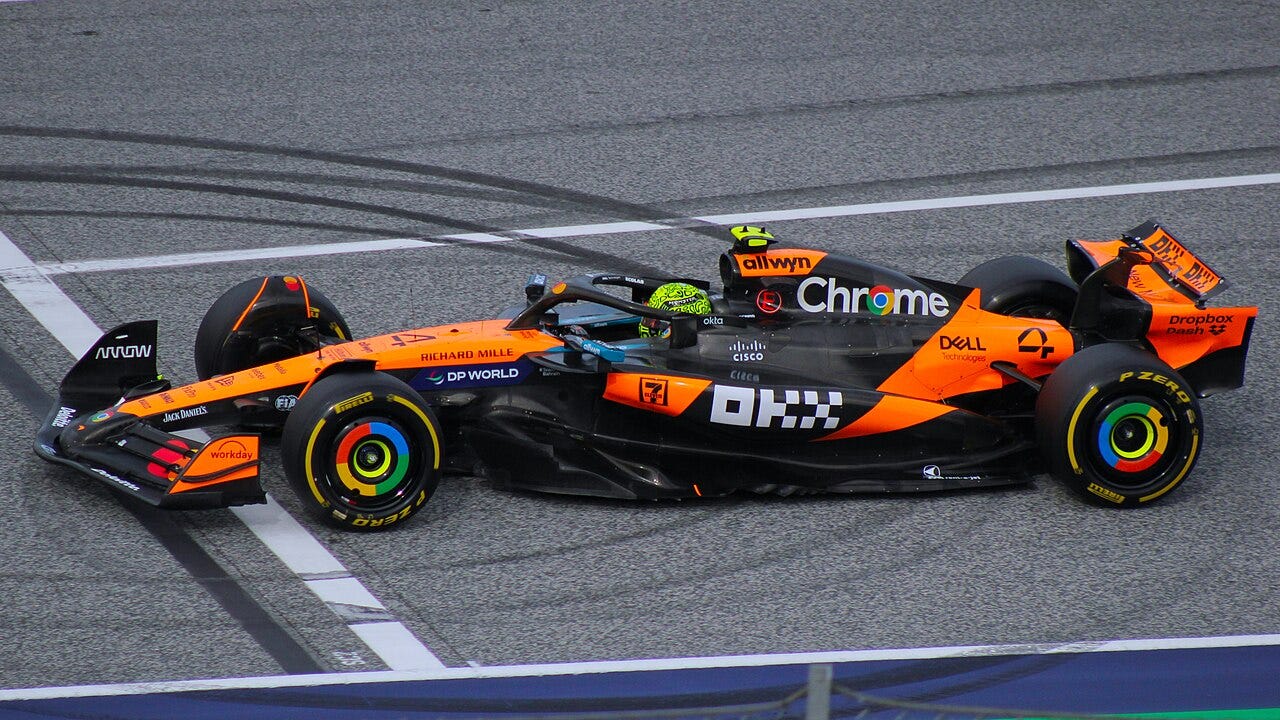
Ten corners, 4.318 kilometres, 71 laps, three heavy braking zones, and not much time to recover when the tyres start cooking. It is short, sharp, and faintly rude. A lap disappears in just over a minute, which means mistakes are not just punished; they are advertised immediately to everyone with a stopwatch and a smug expression.
So yes, Austria is Red Bull’s home race in the marketing sense. But the timing sheets have become less sentimental. Max Verstappen owns the modern history of this place: five wins and eight podiums from 13 starts at the circuit since 2014, including those dominant Red Bull Ring afternoons when the orange grandstands felt less like spectators and more like a weather system. But the last two Austrian Grands Prix were won by George Russell and Lando Norris. In 2025, McLaren went one-two with Norris ahead of Oscar Piastri, while Verstappen did not finish. In 2024, Russell won, Piastri was second, and Verstappen was only fifth.
That is the thing about circuits. They remember greatness, but they do not owe anyone a sequel.
The championship arrives in Spielberg with Andrea Kimi Antonelli still leading, but carrying the first proper bruise of his season. Barcelona should have been another Mercedes statement. Russell put it on pole, Antonelli qualified third, and the W16 looked more than healthy enough to keep Ferrari honest. Then Lewis Hamilton and Ferrari produced the kind of strategic win that makes engineers pretend they were calm all along.
Hamilton started second, beat Russell, and won by 19.561 seconds. Norris finished third, Verstappen fourth and 40 seconds off the winner, and Antonelli retired late after briefly looking ready to salvage a heavy points day. One DNF later, the rookie still leads the championship, but his cushion over Hamilton is down to 41 points: 156 to 115. Russell sits third on 106. Mercedes still lead the constructors by 72 points over Ferrari, which is not a crisis. But reliability has a nasty habit of turning “not a crisis” into a meeting with too many pastries and no eye contact.
Ferrari, meanwhile, have spent the week trying to sound sensible while everyone else throws confetti. Hamilton’s first Ferrari win has produced the expected emotional aftershocks: tributes, behind-the-scenes videos, Damon Hill saying Ferrari would be daft not to listen to him, Lando Norris suggesting Ferrari would embarrass everyone with a better engine, and Fred Vasseur doing the team-principal equivalent of asking everyone to breathe into a paper bag.
He is right to be cautious. Barcelona was huge, but Austria is a different examination paper. The Red Bull Ring asks for traction out of slow corners, braking stability into Turns 3 and 4, low-drag efficiency up the hill, and the ability to keep tyre temperatures alive without setting them on fire. This weekend’s forecast is not helping the fire brigade: current forecasts point to roughly 30C on Friday and 32C across Saturday and race Sunday, with only a modest rain risk showing for Sunday. If that holds, this is less a rain-chaos weekend and more a tyre-degradation referendum.
That should interest McLaren. Norris won here last year, Piastri was second in both 2024 and 2025, and the papaya car has repeatedly looked comfortable when the race becomes about looking after rubber without falling asleep. Norris is only two points behind Leclerc in the drivers’ standings, and McLaren’s 2025 Austria form was not a fluke; it was a warning label.
It should also interest Russell. His 2024 win here was opportunistic, yes, but opportunism is a racing skill, not a clerical error. He has been excellent over one lap this season, took pole in Barcelona, and sits close enough to Hamilton that Mercedes cannot let the intra-team conversation drift. Toto Wolff has already had to think about rules of engagement. Austria, with its short lap and traffic compression, is a delightful little place to test whether everyone read the memo....
And then there is Verstappen. Seventh in the drivers’ championship would have sounded like satire two seasons ago. Red Bull are fourth in the constructors, behind Mercedes, Ferrari and McLaren. The car has been useful in flashes, awkward in stretches, and politically noisy in the background, with Liam Lawson’s Red Bull exit narrative still being swatted around in the headlines. Isack Hadjar’s Barcelona P6 was encouraging. Verstappen’s Austria record is still monstrous. But history does not produce downforce.
The hidden gem in the data is not that Verstappen is good here. Everyone knows that. It is that Hamilton has quietly matched Verstappen’s 194 points at this circuit since 2014, despite fewer wins, and has finished fourth here in each of the last two seasons. If Ferrari’s Barcelona pace was real rather than circumstantial, Hamilton does not need the Red Bull Ring to become a Ferrari circuit. He just needs it to become a hot, high-deg, strategically flexible Sunday where experience matters.
Austria will not decide the championship. Round 8 never does, unless someone starts doing mathematics with a chainsaw. But it may tell us whether Barcelona was Ferrari’s spark or merely Ferrari’s postcard, whether Antonelli’s lead is solid or stress-tested, and whether Red Bull can still make their own house feel uncomfortable for everyone else.
The hills are beautiful. The lap is brutal. And by Sunday afternoon, someone is going to discover that ten corners can ask an awful lot of questions.