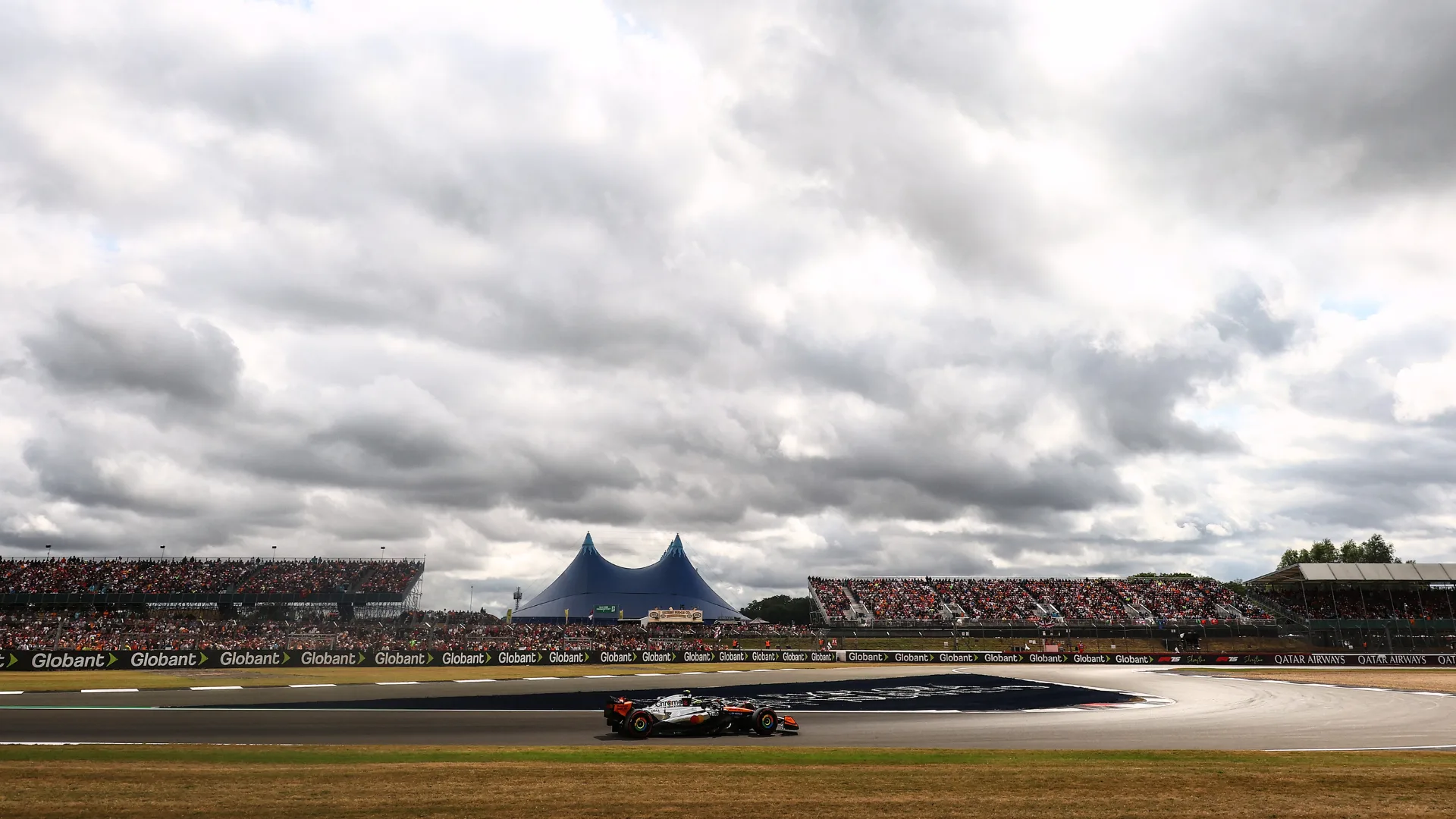
Silverstone does not do subtle. It does not whisper its verdict through a fiddly chicane or hide behind Monaco-style procession theatre. It loads the car through Copse, Maggotts, Becketts and Stowe, asks the tyres whether they fancy another 5g argument, and then lets the wind have a vote.
This weekend, for round nine of the 2026 Formula 1 season, it gets an extra accelerant: the British Grand Prix is a Sprint weekend. According to F1 Daily Brief schedule data, the race is set for Sunday, July 5 at Silverstone Circuit, with the event marked as a Sprint round and not yet completed. One practice session before parc fermé pressure begins. Or, in plain English: if your baseline setup is wrong on Friday, the weekend starts looking at you like a disappointed headmaster.
Silverstone rewards confidence, but it punishes assumption. On a Sprint weekend, the difference between bravery and overconfidence can be one gust of wind through Copse.
The place itself is the story before any car turns a wheel. F1 Daily Brief’s circuit data lists Silverstone at 5.891km over 52 race laps, with its first grand prix in 1950. It remains one of the calendar’s purest aero examinations: sustained high-speed load, long corners, direction changes where front-end trust is not optional, and enough exposure to the weather to make every race engineer glance nervously at the flags.
The weather, unusually, appears to be on its best behaviour — which in Northamptonshire usually means it is hiding something. Formula 1’s official forecast calls for dry running all three competitive days: Friday from 12-24°C with 0% rain chance, Saturday up to 26°C with 0% rain, and Sunday from 16-24°C with 0% rain. Open-Meteo broadly agrees, showing daily highs of 23.7°C, 23.7°C and 25.4°C from Friday to Sunday, with maximum precipitation probability at 0%, 2%, and 0% respectively.
So no classic Silverstone rain lottery, at least on the current forecast. The hold is wind and track temperature. F1 warns of Saturday gusts potentially in the 35-45 km/h range, perhaps approaching 50 km/h, while Open-Meteo shows Saturday as the breeziest day. F1 also expects track temperatures around the low 40s. That combination matters: Silverstone’s fast direction changes are sensitive to yaw and crosswind, and warm track temperatures can push front tyres into complaint mode if teams chase too much qualifying sharpness.
Historically, no active driver owns this place like Lewis Hamilton. Using the Jolpica/Ergast Silverstone results dataset, Hamilton has 20 Silverstone F1 starts, nine wins, 15 podiums and 343 points at the circuit. That includes his Mercedes years, his McLaren beginnings, and now the emotional complication of returning in Ferrari red. If Ferrari gives him a car with balance through the fast stuff, the muscle memory is absurdly deep.
Max Verstappen is the next major active benchmark at Silverstone: 12 starts, two wins, five podiums and 144 points. Worth noting: that is Silverstone F1 races, not only British Grands Prix, because 2020 added the 70th Anniversary GP. Fernando Alonso, being Fernando Alonso, has basically been racing here since the circuit was lit by candles: 22 starts, two wins, six podiums and 128 points.
For the current British hopes, Lando Norris has the most recent magic. The Jolpica/Ergast data records eight Silverstone starts for Norris, one win, three podiums and 90 points — with the win coming in 2025. George Russell, by contrast, has eight Silverstone starts with a best finish of fifth and 11 points. That is not a verdict on his talent; it is a reminder that home pressure and home performance are not the same animal.
Oscar Piastri is quietly relevant too. His Silverstone F1 record is still short — three starts — but already includes a podium and three top-four finishes: fourth in 2023, fourth in 2024, second in 2025. That is not a bad relationship with a track that punishes drivers who need three laps to introduce themselves to the front axle.
The team history is just as loaded. Ferrari leads active constructors in the Silverstone dataset with 15 wins and 48 podiums. McLaren follows with 13 wins and 30 podiums. Mercedes has nine wins and 20 podiums, Williams eight wins and 18 podiums, and Red Bull five wins and 15 podiums. It is a wonderfully British sort of statistic that so many teams can claim this place as historically significant, and most of them will still spend Friday arguing with the wind.
The news cycle since Austria has been busy enough to need its own pit wall. F1 Daily Brief’s feed has the official British GP weather forecast, F1’s home-race historical analysis, and the return of the Lego drivers’ parade — 22 driveable minicars, per Sky Sports and Autosport coverage. Charming, ridiculous, and probably the only cars all weekend that won’t be blamed for tyre degradation.
The more serious paddock threads are sharper. The Race reports Honda has now put a date and some detail around its 2026 engine upgrade programme. Motorsport.com reports Carlos Sainz is not really considering his F1 future beyond Williams until the summer break. The Race also has Gary Anderson’s analysis of Cadillac’s recurring brake overheating problem, a reliability concern that matters more on Sprint weekends because there is less time to diagnose and more competitive running to expose whatever the car is trying to confess.
There are hidden storylines everywhere if you look past the obvious Union Jack theatre. Williams brings home pressure and development pressure together; Silverstone is not merely a race for Grove, it is a progress audit. Cadillac’s brake-cooling compromise is one to watch because Silverstone is not the harshest braking circuit, so if problems persist here, the issue is not just track-specific. McLaren returns to the scene of Norris’s 2025 win needing proof that current pace and reliability can meet in the same room. Ferrari has history and Hamilton emotion, but history does not generate downforce and emotion does not save the tyres.
And then there is the Sprint format, the weekend’s great nonsense amplifier. It rewards teams that unload cleanly, drivers who can live with imperfect balance, and engineers who can separate a genuine setup issue from one angry gust across a fast corner. Silverstone will not answer everything about the 2026 season. But it will ask the right questions, loudly.