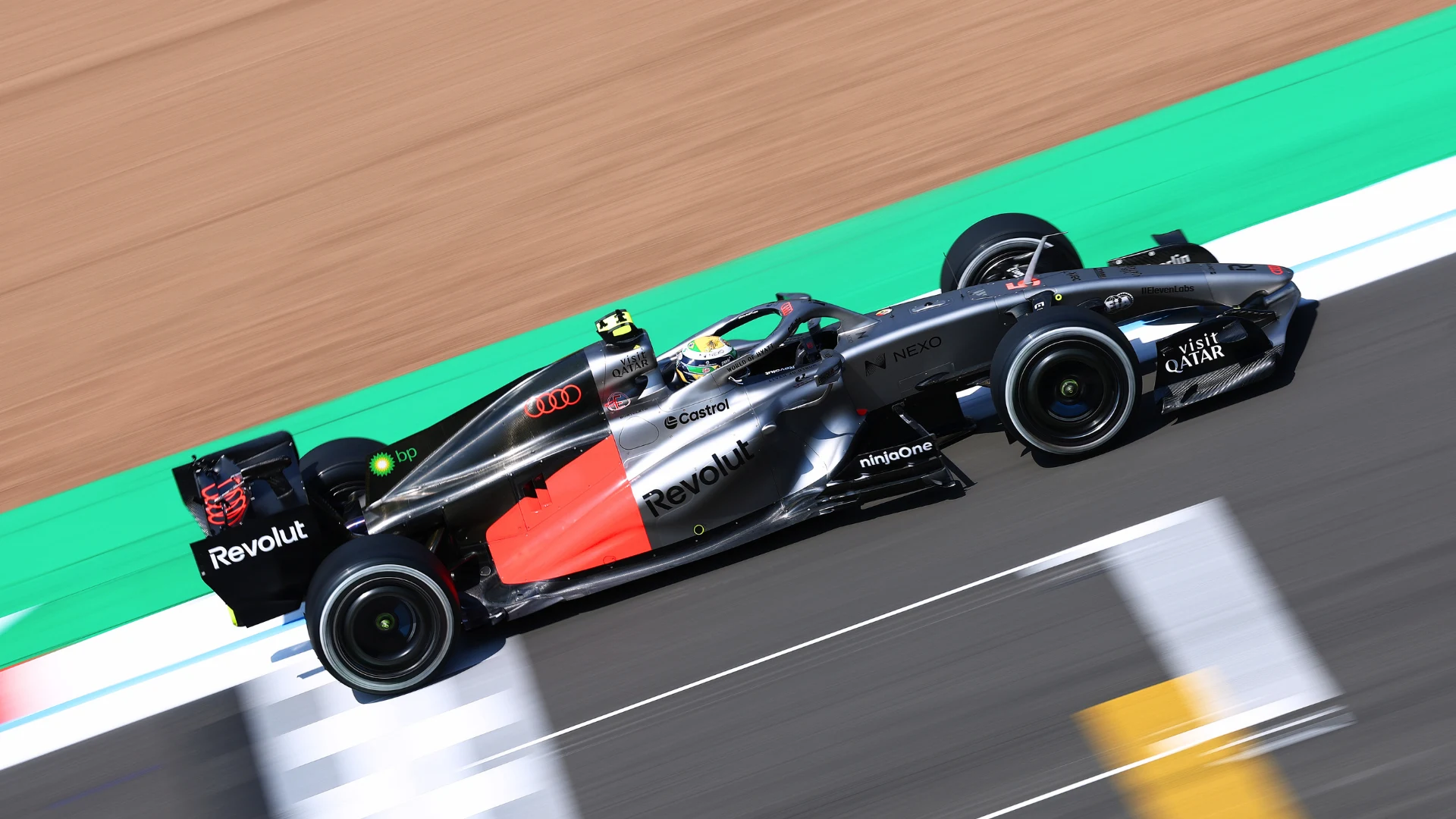
Silverstone has a habit of making nonsense of tidy predictions, usually while wearing a flat cap and pretending it was obvious all along. Friday at the 2026 British Grand Prix did exactly that: Lewis Hamilton fastest in FP1, fastest in SQ1, fastest in SQ2, fastest in SQ3, and now sitting on Sprint pole for Ferrari at a circuit many expected to expose the red car’s weaknesses rather than flatter them.
The numbers were not decorative. Hamilton’s FP1 benchmark was a 1:29.260, with Andrea Kimi Antonelli 0.213s back and Charles Leclerc 0.599s adrift in third. George Russell, Oscar Piastri, Max Verstappen, Lando Norris, Isack Hadjar, Nico Hülkenberg and Liam Lawson completed the top ten. That session already hinted at two things: Ferrari had arrived with a usable car, and McLaren had work to do. Piastri spun at Becketts; Norris had a scruffy hour with track limits and an aborted lap. Not catastrophic, but hardly the sort of Friday that makes engineers whistle merrily into their laptops.
Then Sprint Qualifying made the picture sharper — and stranger. Hamilton’s 1:28.376 beat Antonelli by just 0.011s. Verstappen took third on 1:28.697, only 0.006s ahead of Leclerc, with Russell fifth, Norris sixth and Piastri seventh. From Verstappen in P3 to Piastri in P7, the spread was 0.075s. That is not a gap; that is a sneeze with a timing transponder.
Saturday’s Sprint will not tell us everything about the British Grand Prix, but it will tell us whether Ferrari’s Friday pace is a proper weapon or merely a beautifully timed surprise party.
The Sprint itself is 17 laps, starting at 12:00 BST / 7:00 ET. Hamilton has the cleanest view into Abbey, but Antonelli has looked comfortable all day and Mercedes will not treat 0.011s as a compliment. The Italian missed pole by the sort of margin that makes race engineers stare silently at sector overlays for too long. For Mercedes, the split garage picture matters: Antonelli looked like a win threat; Russell described a lack of pace, while Mercedes’ Andrew Shovlin noted the car had too much front in gusty conditions and was losing on straight-line speed.
That wind detail matters. Silverstone rewards commitment through the fast stuff, but a gusty car is a confidence tax. Saturday is expected to be warm, mostly dry, with some sunshine and breeze. No rain lottery is forecast, which means the Sprint should be about start execution, tyre control and who can keep the platform happy through the high-speed sequence rather than who guesses the clouds best.
Ferrari’s opportunity is obvious, but so is the question. Formula1.com’s Friday debrief credited Ferrari with a low-speed corner advantage: about 0.3s over Red Bull, 0.4s over Mercedes and more than half a second over McLaren. That helps explain why Hamilton could look so unexpectedly strong at Silverstone, but it does not automatically guarantee race pace across 17 laps or Grand Prix pole later in the afternoon. Sprint weekends are cruel because the evidence arrives fast and ages faster.
Verstappen starts third, which is exactly the sort of position from which he can make everyone regret giving him oxygen. But even he sounded wary of the margins, saying P3 could easily have been P6 or P7. Red Bull is still chasing cornering and deployment improvements, and at Silverstone those are not side quests. If Verstappen cannot stay close through the first half-lap, Hamilton and Antonelli may get the private duel the timing sheets promised.
McLaren’s Saturday is more complicated. Norris suffered front brake duct damage in SQ2, which the team repaired before SQ3. He said the car felt “pretty shocking” until the fix, and McLaren’s own assessment was that P6/P7 broadly reflected the pace. That is the uncomfortable bit. Damage explains some of Norris’s session, but Piastri also ended seventh after admitting the car had improved only “a bit” and not enough. If McLaren wants to fight in Grand Prix qualifying at 16:00 BST / 11:00 ET, it needs more than a cleaner session; it needs a better operating window.
Do not ignore Racing Bulls either. Lawson P9 and Arvid Lindblad P10 put both cars into SQ3, which is useful track position in the Sprint and a warning shot for qualifying. On a day when tiny gaps separated the sharp end, a well-balanced midfield car can become deeply annoying to supposedly faster machinery. Annoying, in Formula 1, is often just another word for effective.
So Saturday has two jobs. First, the Sprint: can Hamilton convert pole, can Antonelli attack without overcooking it, and can Verstappen turn third into something nastier? Second, Grand Prix qualifying: can Ferrari reproduce its Friday peak when the main grid is on the line, or will Mercedes, Red Bull and McLaren spend the afternoon moving the goalposts?
Silverstone has given us the ingredients. Now it gets to apply heat.
Sources / Editorial fact-check
- F1 Daily Brief API:
/api/v1/news,/api/v1/races?year=2026,/api/v1/drivers,/api/v1/teamsverified the British GP as 2026 round 9, sprint weekend, Silverstone; and confirmed driver/team internal IDs used in links. - Formula1.com: FP1 and Sprint Qualifying reports/team notes verified Hamilton’s FP1/SQ pace, Sprint pole time, Antonelli margin, SQ order, Ferrari low-speed advantage, Mercedes/Red Bull/McLaren comments, and Norris brake duct damage.
- Motorsport.com: Saturday schedule/weather article verified Sprint at 12:00 BST / 7:00 ET, qualifying at 16:00 BST / 11:00 ET, 17-lap Sprint context, and warm mostly dry/breezy forecast.