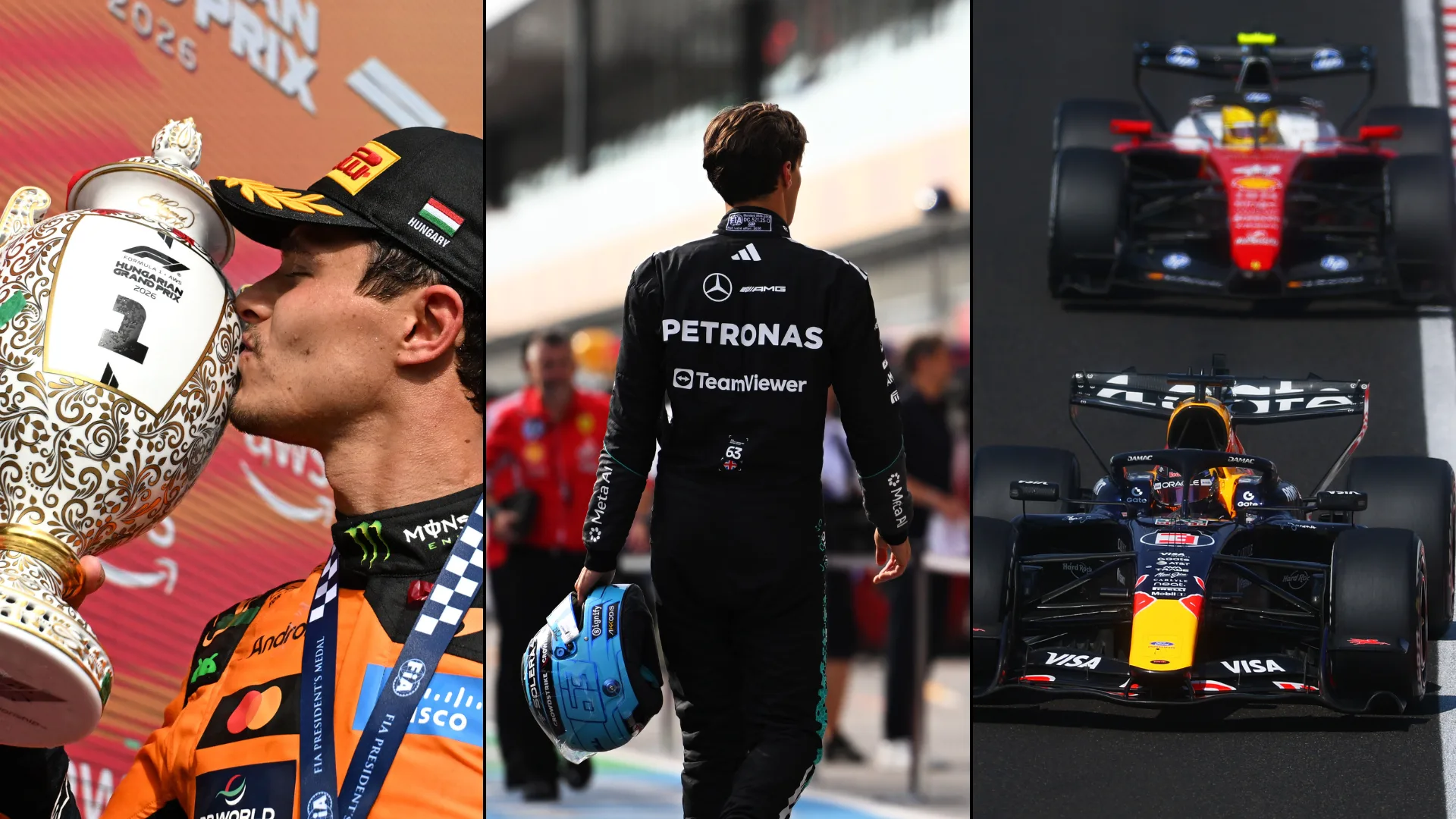
Lando Norris gave McLaren its first Grand Prix victory of 2026. Further back, Aston Martin's upgraded AMR26 did not score, but it finally gave the team something stronger than optimism to take into the summer break.
Lando Norris did what pole-sitters are supposed to do at the Hungaroring, though not quite in the tidy way the sentence suggests. He started first, finished first, and gave McLaren its first Grand Prix win of the season. Between those two fixed points, Hungary produced enough traffic, penalties, radio irritation and strategic second-guessing to keep the stewards busy and the pit walls looking as if someone had changed the password to the race.
Norris won by 15.080 seconds from Max Verstappen, with Kimi Antonelli third. Charles Leclerc finished fourth and Lewis Hamilton fifth, after Hamilton's afternoon was trimmed by a five-second penalty for pit-lane speeding. Oscar Piastri, who had taken the lead from Norris at Turn 2, retired late with a gearbox problem after an earlier collision while lapping Carlos Sainz. Sainz was given five seconds for causing that collision; Oliver Bearman also received five seconds for ignoring blue flags.
That is the result sheet. The race itself was more untidy.
Piastri's launch briefly gave McLaren the pleasant problem of controlling a race with both cars. It did not last. Once he lost time in the Sainz incident and later retired, Norris had the air and rhythm to turn a potentially complicated internal McLaren afternoon into a clear result. Verstappen, starting fourth and finishing second, again extracted more from a weekend than the Red Bull had promised in qualifying. Antonelli's third place, from seventh on the grid after his qualifying penalty, mattered as much for the championship as for the podium ceremony.
The pre-race penalties had already rewritten the front of the grid. Hamilton had qualified second but was dropped three places for impeding Piastri in Q3. Antonelli, originally fourth, was also given a three-place penalty for not slowing sufficiently under yellow flags. Those penalties helped put Piastri third and Verstappen fourth on the adjusted grid, and they left Hamilton needing a race of precision that never quite arrived.
For Hamilton, the Hungarian weekend will sting through the shutdown. The pace was there. The execution was not. A qualifying infringement, then a pit-lane speeding penalty, left Ferrari with Leclerc fourth and Hamilton fifth on a day when the podium was not outlandish. The damage in the drivers' championship is measurable: Antonelli now leads with 219 points, 50 clear of Hamilton, after 11 of 23 races.
Formula 1 now goes quiet until the Dutch Grand Prix at Zandvoort on August 23. That makes Hungary more than a race result. It is the note everyone has to live with during the break. McLaren finally has a win. Mercedes still has the points lead. Ferrari has speed and irritation in roughly equal supply. Red Bull has Verstappen holding up the architecture. And Aston Martin, unexpectedly, has a question worth taking seriously.
Aston Martin: real progress, carefully measured
For Aston Martin, the easy version of the story is also the wrong one. Lance Stroll finished 13th and Fernando Alonso 14th. No points. No headline result. No reason to pretend that a team sitting 10th in the constructors' standings, on one point, has suddenly found the front half of the grid.
But if the question is whether Aston Martin looked better in Hungary, the answer is yes. More importantly, the data supports a cautious yes.
The first sign came before the race. Alonso qualified 16th and reached Q2, while Stroll qualified 20th. That still reads modestly, because it is. Yet OpenF1 timing data across the earlier 2026 weekends shows how low the baseline had been: before Hungary, Aston Martin's best qualifying rankings were normally in the high teens or last two rows. At Spa, Alonso and Stroll were 21st and 22nd by best qualifying lap. At Silverstone, they were again 22nd and 21st. In Austria, 21st and 22nd. Spain was no kinder. Against that pattern, Alonso getting the upgraded car into Q2 at the Hungaroring is not a miracle, but it is a break in the trend.
The race pace says something similar, with the usual caveats. A simple clean-lap median from OpenF1 race timing - excluding lap one and obvious slow/pit-affected laps - put Stroll 13th and Alonso 17th among drivers with enough representative laps. That does not make the AMR26 a points car. It does suggest the car was no longer merely circling at the back waiting for attrition. Stroll's median clean lap was in the same lower-midfield band as Liam Lawson, Nico Hulkenberg, Pierre Gasly, Arvid Lindblad, Gabriel Bortoleto and Franco Colapinto. Alonso's race was less convincing on that measure, but his best lap was competitive enough to stop the weekend being dismissed as a qualifying-only bump.
The classification also matters. Stroll rose from 20th on the grid to 13th, Alonso from 16th to 14th. Some of that came from retirements and penalties elsewhere, because racing is not a laboratory and Hungary was not tidy enough to become one. Still, both Astons finished ahead of the Haas and Williams entries and within the broader lower-midfield group. That was not the usual 2026 Aston Martin shape.
Aston Martin did not leave Hungary with proof of a recovery. It left with something almost as valuable: evidence that its development direction may finally be connected to the stopwatch.
That distinction matters. A one-off Hungaroring gain can flatter a car. The circuit rewards downforce, traction, balance in medium-speed corners and confidence over kerbs. It is also relatively hard to overtake, which can turn a good Saturday into a better Sunday, or a bad Saturday into a long apology. Aston's upgrade therefore cannot be declared a success across the calendar until it travels to circuits with different demands.
Zandvoort will be a useful next test because it is still corner-heavy but asks a different set of questions: banking, wind sensitivity, rotation through long loaded corners, and a narrower operating window. Monza after that will be harsher still. If the new package only works when maximum downforce hides its compromises, the story will fade quickly. If it gives the team a more predictable platform, the summer break may become the point at which Aston stopped losing the season by default.
There is also the operational side. Stroll's FP1 suspension failure on the upgraded package was a reminder that parts arriving at the circuit and performance arriving on demand are different things. Large updates create pressure on spares, setup time and correlation work. They can move a team forward, but they can also consume a weekend if reliability or preparation lags behind the design ambition.
So the fair verdict is this: Hungary supports the idea that Aston Martin improved, but not the idea that Aston Martin is fixed. The qualifying data gives the strongest evidence because Alonso crossed a threshold the team had repeatedly missed. The race data gives secondary support because Stroll's representative pace sat closer to the lower midfield than to the tail. The result, 13th and 14th, keeps the celebration suitably small.
That may sound restrained. It should. Aston Martin has been too far away for one weekend to rewrite the season. But the team went into Hungary looking like it needed a direction and came out with a direction worth testing. In a midfield where one clean Saturday can be the difference between points and anonymity, that is not nothing.
For Norris and McLaren, Hungary was a release. For Antonelli, it was a championship-management day with a trophy attached. For Hamilton, it was another weekend of speed being taxed by mistakes. For Aston Martin, it was quieter and perhaps more important: not a breakthrough result, but the first credible data point in a long time that says the car might be moving toward the fight rather than away from it.
The summer break will decide nothing. It will, however, give every team three weeks to decide which Hungarian lessons were real. Aston Martin finally has one worth protecting.