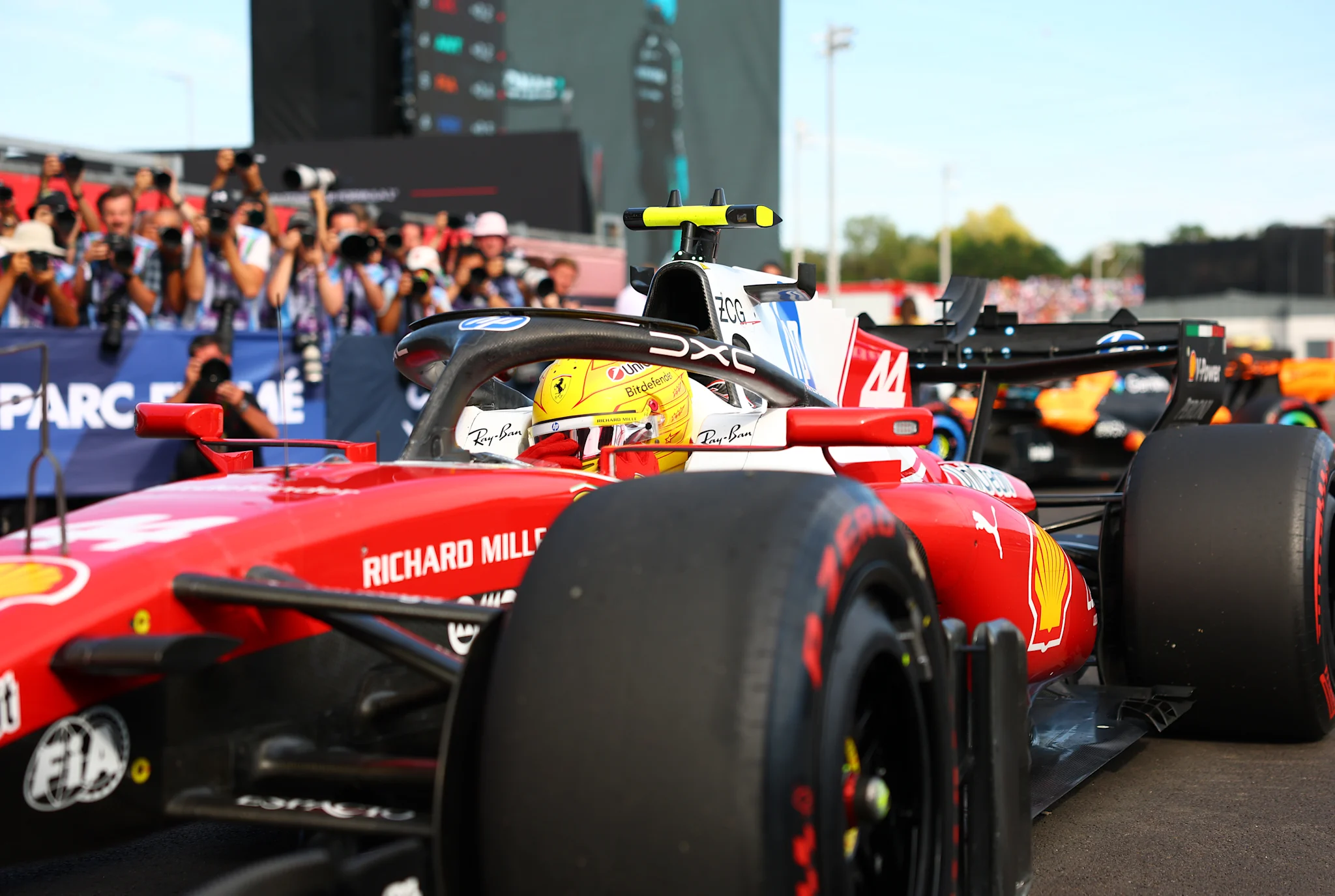
There was no single team that owned every hour at the Hungaroring, but Saturday belonged to Lando Norris when it mattered. After Ferrari set the pace on Friday, Norris was quickest in final practice and then found a 1:17.207 at the end of Q3 to take pole for the Hungarian Grand Prix by 0.012 seconds.
That is a very small margin with a very large consequence. The Hungaroring has one credible overtaking zone and an unfortunate habit of rewarding the car that arrives there first. Pole is not a guarantee of victory, but it is a useful way of avoiding an afternoon spent examining another car's rear wing.
Friday had suggested Ferrari would arrive in qualifying as the reference. Charles Leclerc led FP1 before a late mechanical problem, and Lewis Hamilton headed FP2 from his team-mate, with Norris third. The balance of power shifted again on Saturday morning. Norris topped FP3 from Hamilton and Kimi Antonelli, while Leclerc and Oscar Piastri completed a leading group separated by less than half a second.
The useful lesson from practice was not that Ferrari lost its way or McLaren suddenly found a miracle. It was that Budapest is again doing what Budapest tends to do: compressing the field, changing the grip window by session, and forcing teams to decide whether they are chasing a clean qualifying lap or a tyre platform that will still make sense after 25 laps on Sunday. Ferrari looked comfortable early. McLaren looked sharper late. Mercedes had moments of pace without a clean through-line. Red Bull, unusually, spent more time discussing balance problems than threatening the stopwatch.
The decisive runs required a clean lap rather than an elaborate theory. Norris delivered one. Hamilton initially qualified second, with Leclerc third, but a three-place penalty for impeding Piastri placed Hamilton fifth on the final grid. Antonelli also received a three-place drop for failing to slow sufficiently under yellow flags after Max Verstappen's Q3 spin, moving him from fourth to seventh.
That is the confirmed post-qualifying grid story. There has been no further verified change affecting Sunday's starting order since those penalties. George Russell, who stopped in Q3 because of a water-pressure issue, will take a fresh power unit, but Mercedes has described it as a like-for-like change within his allocation. That means no grid penalty and no pit-lane start. The revised top ten stands as Norris, Leclerc, Piastri, Verstappen, Hamilton, Russell, Antonelli, Isack Hadjar, Arvid Lindblad and Nico Hulkenberg.
At the Hungaroring, grid position is not everything. It is merely the thing every strategy meeting spends Saturday night trying to escape.
Hamilton's penalty is more than a clerical adjustment. Starting second here would have made him Norris's immediate problem into Turn 1. Starting fifth means he has to clear cars that will not move politely just because the Ferrari was fast on Friday. The same applies to Antonelli, who looked increasingly convincing as Saturday went on before the yellow-flag decision turned a potential second-row launch into a recovery race from seventh.
Russell's case is different. His issue did not cost him grid places after the stewards finished their work, but it still matters. A Saturday stoppage, a power-unit change and a race start from sixth is not a calm preparation at a circuit where airflow, tyre temperature and traffic are all capable of turning a strategy model into expensive stationery. Mercedes believes its race pace from Friday gives it a route forward. The question is whether that pace survives in dirty air.
Aston Martin's first evidence
The more consequential story may sit further back. Aston Martin arrived in Budapest with a 16-part upgrade package after a season without progress beyond Q1 in a grand prix qualifying session. The revised AMR26 is not suddenly a front-running car, and one Q2 appearance is not a recovery. It is, however, the first hard sign that the direction has changed.
Fernando Alonso reached Q2 for the first time this year and qualified 16th. Lance Stroll qualified 20th after losing nearly all of Friday to a suspension issue and then being limited to reduced running in FP3. The contrast between the two cars means Saturday cannot establish a clean Aston-versus-Aston comparison, but it also makes Alonso's result worth treating seriously rather than as a convenient headline.
The technical intent is coherent. Formula 1's analysis describes revised front-wing and nose geometry, floor and diffuser work, sidepod changes and altered rear-suspension details, aimed at making diffuser airflow more robust and higher rear ride heights more usable. In plainer language, Aston Martin appears to be seeking a wider operating window, not merely a qualifying trick. The AMR26 must still carry this gain across different circuits and race distances. But after a run of Q1 exits, Q2 is a reasonable first receipt.
It also changes what Sunday should be used to measure. Points would be welcome; they are not the only test. Aston needs to know whether the upgraded car keeps its rear tyres alive, whether Alonso can attack and defend without the balance disappearing, and whether Stroll's lost running has hidden or merely delayed the second car's version of the same progress. That is less glamorous than a points finish, but it is how a team turns an upgrade from a press release into a development direction.
Sunday is a position race with a tyre argument
Pirelli has brought the C3, C4 and C5 compounds, and its latest race simulations suggest the one-stop and two-stop routes are unusually close on total time. Higher-than-expected degradation has pulled the two-stop back into play, but the circuit's overtaking difficulty still pushes teams toward controlling track position. That is the Hungarian argument in miniature: the tyres may invite action, while the track warns against making life complicated.
The medium is expected to be the preferred starting tyre for most of the grid. A one-stop would likely ask drivers to manage the first stint carefully before moving to the hard between roughly laps 26 and 32. A two-stop brings the first stop earlier, around laps 16 to 22, then a second window later in the race, but it demands clear air or a pace offset large enough to justify giving up position.
Norris has the first choice of clean air, but Ferrari's Friday form and Leclerc's move to the front row give him a serious rival at the start. Piastri is close enough to matter to McLaren's race, particularly if he can pressure Leclerc early rather than spend the first stint watching tyre temperatures rise. Verstappen's fourth is more respectable than his final Q3 looked; his spin curtailed his last effort and Red Bull's weekend has not carried much of the serene competence usually associated with its better Saturdays. Still, a Verstappen starting fourth at a circuit that punishes mistakes is not exactly background decoration.
Hamilton's fifth place creates the race's most obvious tactical tension. Ferrari appears to have had competitive long-run pace, and Hamilton was fast enough across practice and qualifying to be a victory factor on raw speed. But raw speed is not the same thing as usable speed. If he spends the opening stint behind Verstappen or Piastri, Ferrari may be forced into the undercut argument earlier than it wants. If he clears them quickly, Norris and Leclerc will have less room to manage.
Mercedes has a similar but sharper problem. Russell starts sixth with a fresh power unit and a weekend that has already asked too much of the garage. Antonelli starts seventh after looking like a podium threat before the yellow-flag penalty. Both need progress, neither can afford to abuse the tyres to get it, and both will have midfield cars close enough behind to punish hesitation. On a normal circuit, that would be merely inconvenient. At the Hungaroring, it is the race.
For Aston Martin, the brief is smaller but no less important. Alonso starts in a crowded part of the field on a circuit that punishes compromised tyre life and rewards patience. The useful test is whether the upgraded car remains predictable over a full stint, and whether it gives its driver options rather than simply a faster single lap. Stroll's compromised weekend makes the second data point thin, but Sunday can still tell Aston whether the new package works when the fuel comes in and the clean air disappears.
Sunday's race begins at 15:00 local time, 13:00 UTC. Norris has earned the best place to control it. Ferrari has enough pace to disturb him, McLaren has a second car close enough to help or complicate the picture, and the penalty reshuffle has placed two fast Mercedes-powered drivers in the part of the grid where patience and frustration tend to meet. Budapest rarely gives much away. This year, at least, it has arranged the questions properly.
Sources / Fact-check notes
- F1 Daily Brief API:
/api/v1/news,/api/v1/races?year=2026,/api/v1/drivers,/api/v1/teams, and/api/v1/circuits. Verified: event, round, circuit, race time, and driver/team identifiers. - Formula 1, qualifying report: verified Norris's pole time and margin, original qualifying order, post-penalty starting order, Verstappen's spin, Russell's Q3 stoppage, and Alonso/Stroll qualifying positions.
- Formula 1, FP1 report, FP2 report, and FP3 report: verified the practice-session summaries and Stroll's lost running.
- Formula 1, Aston Martin technical analysis, Alonso Q2 report, and tyre preview: verified the 16-update package, its stated technical direction, Alonso's first Q2 of 2026, tyre compounds and strategy considerations.
- Formula 1, Mercedes update: verified Russell's water-pressure issue, power-unit replacement and absence of a grid penalty or pit-lane start.
- Formula 1, strategy guide, and Sky Sports, post-qualifying grid penalties report: verified post-qualifying grid context and Sunday strategy framing.
Editorial note: Post-qualifying checks found no confirmed parc ferme breaches, pit-lane starts, disqualifications, or further grid-changing decisions beyond the Hamilton and Antonelli penalties. Refresh once more against the final FIA starting grid before lights out if publishing close to race start.